


12 practical tips for successful insemination
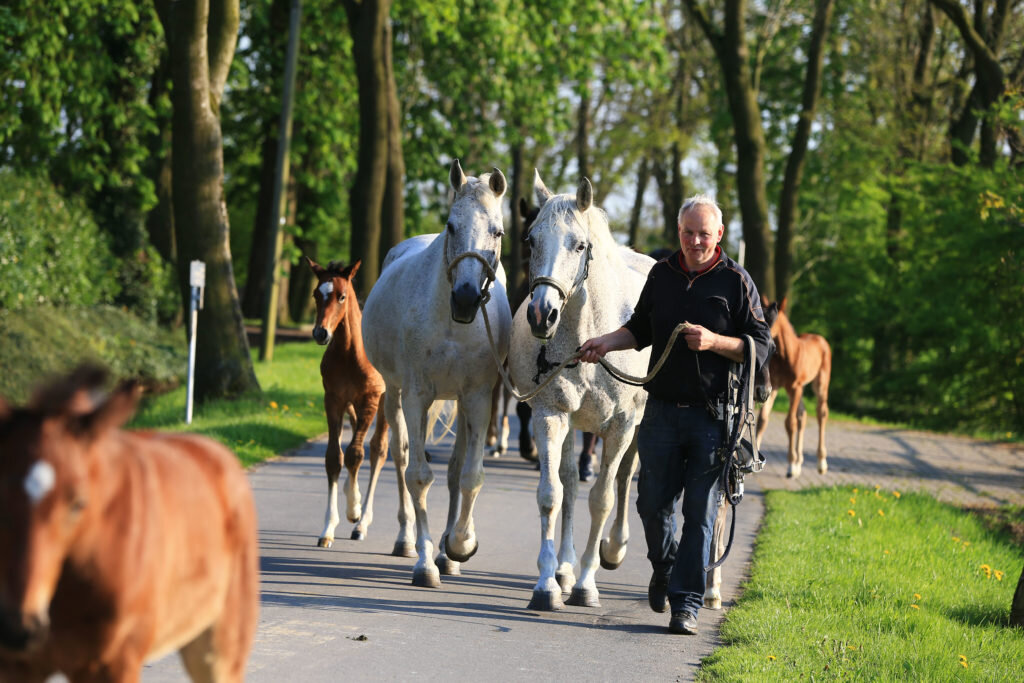

Would you like to have a foal from your mare? Rainer Böning, our long-standing head of the breeding centre, has put together twelve helpful practical tips for optimum breeding management to make your wish come true.
1) Enable free movement
Provide fresh air and sufficient opportunities for exercise. If the mare is not kept on pasture or in a loose stable, free movement should be made possible on an ad hoc basis.
2) Ensure social contact
Horses are herd animals and social contact with other (preferably familiar) horses is important. We recommend daily grazing in a herd. However, if your mare is the only one in the group that is not yet in foal, she may need to be separated. The mare may adapt to the herd and no longer show heat.
3) Avoid stress
Many mares come into heat best in a familiar atmosphere. You should therefore avoid stress, e.g. isolation, relocation, transport, restlessness and unfamiliar social contact. Sensitive horses can react strongly to this. However, for some mares that do not come into heat at home, a change of stable can even have a positive effect.
4) Switch on the light
Whilst the cycle is positively influenced by nature in the pasture in summer, we can help with artificial light in winter.
We have good experience with light programmes to support the heat cycle. As winter draws to a close, around February, we switch on very bright lights in the stalls from 6 am to 8 pm.
5) Taking sport mares out of sport
A sport mare must first get used to the new task. We recommend taking competition horses out of sport at an early stage, removing the shoes and keeping them with other broodmares.
6) Pay attention to feed condition
A good feed condition is important for the mare to pick up. Mares with a lean constitution usually become pregnant more easily. Mares that are too fattened should "slim down" in autumn if they are to be inseminated in spring. Ensure an appropriate supply of energy and nutrients.
Our mares receive very high-Quality pasture grass during the grazing season and sufficient quantities of hay from our pastures in winter. We ensure the supply of nutrients with lick trays from horslyx. Read the Blog post by Dr Hans-Peter Karp on feeding broodmares and foals
7) Ensure vaccination protection
We vaccinate our large herd against tetanus and influenza. We also attach great importance to basic immunisation against herpes and booster vaccinations in the 5th, 7th and 9th month of pregnancy.
8) Plan deworming
Generally, individual deworming according to need and herd size as well as an annual faecal examination are advisable.
9) Observe the cycle
The mare must have a normal cycle, she must be in heat so that she can become pregnant. Typical signs of heat, i.e. readiness to mate, are seeking proximity to other horses, urination and "flashing".
It is best to observe these signs of mating and document them in the calendar. You will then be able to recognise a regularity that will be used for the following mounts and the optimum insemination times. The heat lasts about a week.
10) Teasing
A particularly important point is the teasing of the mare. This involves placing the mare in the stall of a male horse. This should be done at intervals of several days to check whether signs of heat are recognisable. This testing also serves to stimulate the mare. Directly before insemination, it promotes the cleansing and emptying of the reproductive tract and the mare will be easier to conceive.
11) Consult an experienced vet
In addition to the breeding station, a vet with extensive gynaecological experience is your competent contact for all aspects of horse breeding. It is best to discuss your project with him at an early stage. Consider together whether it makes sense to have a dab test and agree on the planned dates.
We inseminate our mares "close to ovulation", around the 5th day of the heat. We recommend inseminating once or twice per heat (48 hours apart). The rule is: "As often as necessary, as little as possible". This way you can save on shipping and vet costs.
12) Stay calm
We can create optimal conditions for the mares and, together with the vet, take measures to favour successful insemination. In the end, nature will decide when the mare becomes pregnant. Some mares conceive the first time, others take a little longer to become pregnant. And still others simply have to take a break for a year. Feel free to contact us and/or your vet to discuss how to proceed in the event of problems.
You haven't chosen a stallion for your mare yet? You are sure to find what you are looking for here at Sosath's stallion collection.